
You’ve sent 200 cold emails. You’ve tweaked the subject lines, personalized the first sentences, and still—crickets.
Sound familiar?
It’s not your coding skills holding you back. It’s that you’re selling web development when decision-makers are buying peace of mind. In 2026, the average decision-maker receives over 120 emails a day. If you are a freelance web developer, an agency owner, or a SaaS founder looking to score development contracts, your biggest competitor isn’t another developer—it’s the Delete button.

To stand out, you can’t just talk about code. You have to talk about psychology. You need to understand why a recipient opens an email, why they keep reading, and why they hit “Reply” instead of “Spam.”
In this guide, I’m going to give you three cold email templates for web developers that are engineered for 2026. More importantly, I’m going to break down the open-rate psychology behind every single line so you understand why they work.
Why Cold Email Still Dominates in 2026

Before we dive into the templates, it’s important to address the landscape. Social media DMs are crowded, and paid ads are expensive. Cold email remains the highest ROI channel for web developers because it allows for hyper-personalization at scale.
While LinkedIn DMs average a 3–5% reply rate, well-executed cold emails consistently deliver 8–15% for service providers. The difference? Email lets you control the narrative with psychology; DMs often feel like a sales pitch from the first message.
However, the rules have changed. In 2026, AI detection software is common, and generic templates flagged as “low quality” go straight to the promotions tab or junk folder. Success now hinges on:
- Authenticity: Emails that feel human beat perfect grammar.
- Value-First: You must provide a glimpse of the solution before asking for a call.
- Psychological Triggers: Leveraging curiosity, ego, and the Zeigarnik effect (the brain’s tendency to remember incomplete tasks).
Template 1: The “Website Audit” Hook

Best for: Local businesses, e-commerce stores, or service providers with outdated or slow websites. Key Psychology: Loss Aversion + Zeigarnik Effect.
The Template
Subject Line: Quick question about [Company Name]’s load time
Hi [Name],
I was looking at [Company Name] today because I’m a big fan of [specific product or service they offer]. While browsing, I noticed that your site takes about [X seconds] to load on mobile.
In my experience working with [similar industry] businesses, that delay usually costs about [X]% of potential mobile traffic—which is essentially leaving money on the table.
I ran a quick audit of your site, and the main issue seems to be [specific technical issue, e.g., unoptimized images/render-blocking JS]. It’s actually a straightforward fix.
If you’re open to it, I’d love to send over the full 2-minute audit video showing exactly where the slowdowns are. No obligation—just figured you’d want to know.
Either way, keep up the great work with [something you genuinely admire].
Best,
[Your Name] [Link to Portfolio/LinkedIn]
Why This Works (The Psychology Breakdown)
Subject Line: “Quick question about [Company Name]’s load time” Psychology: Specificity + Curiosity. Mentioning their company name proves it’s not a mass blast, and “quick question” signals a low time commitment—a high open-rate trigger.
Opening: “I was looking at [Company Name] today because I’m a big fan of…” Psychology: Benjamin Franklin Effect. By stating you are a fan, you create a subconscious positive bias. You position yourself as a customer or admirer first, which lowers their guard immediately.
“In my experience… that delay usually costs about [X]%…” Psychology: Social Proof + Loss Aversion. You aren’t just saying the site is slow; you are quantifying the loss. Humans feel the sting of loss twice as powerfully as the joy of gain. Stating they are “leaving money on the table” triggers a response to keep reading.
“I ran a quick audit… It’s actually a straightforward fix.” Psychology: Peak-End Rule. You raise anxiety by naming the problem, then immediately neutralize it by calling it a “straightforward fix.” This removes the fear of a massive, expensive overhaul.
“I’d love to send over the full 2-minute audit video…” Psychology: Reciprocity. Offering free value with zero strings attached triggers the reciprocity instinct—when someone gives us something, we feel compelled to give back (a reply, a meeting, or trust).
Template 2: The “Tech Stack” Upgrade
Best for: SaaS companies, tech startups, or high-growth businesses that value innovation. Key Psychology: Authority Bias + FOMO.
The Template
Subject Line: [Competitor Name] vs. [Company Name] – Tech stack gap
Hi [Name],
I’ve been following [Company Name] for a while—impressed by the growth in [specific metric or news] .
I was doing some research on the tech stacks used by leaders in the [Industry] space, and I noticed a pattern: most top performers (like [Competitor A] and [Competitor B] ) have migrated to [Modern Framework/Tech] , while your site is currently on [Legacy Stack] .
The shift seems to be driven by [specific benefit, e.g., Core Web Vitals/SEO scalability] . For companies at your scale, staying on a legacy stack usually results in higher maintenance costs and slower feature rollouts.
I specialize in modernizing stacks without disrupting live traffic. I put together a high-level roadmap of how a migration might look for [Company Name] —specifically focusing on preserving your current SEO rankings during the transition.
Would you be open to a 10-minute chat to review it?
Cheers,
[Your Name] [Link to Case Study of a similar migration]
Why This Works (The Psychology Breakdown)
Subject Line: “[Competitor Name] vs. [Company Name] – Tech stack gap” Psychology: Competitive Anxiety. Nothing grabs a founder’s attention like a rival’s name. Pitting them against a competitor taps into their innate competitive drive—they have to open it.
“I’ve been following [Company Name] for a while…” Psychology: Mere-Exposure Effect. This signals you’re selective about who you work with. It flatters the recipient by suggesting their company is worth following.
“Most top performers… have migrated to [Modern Framework]” Psychology: Social Proof + Bandwagon Effect. You show them that “the herd” of top performers has already moved. Humans rarely want to be the last to use outdated technology—this creates FOMO.
“staying on a legacy stack usually results in higher maintenance costs…” Psychology: Pain Point Agitation. Instead of selling benefits, you agitate the pain of the old tech. You frame the legacy stack as a “tax” that costs them more over time—reframing the project from an expense to a savings.
“preserving your current SEO rankings during the transition.” Psychology: Risk Reversal. The biggest fear during a rebuild is losing traffic. By addressing this fear directly, you remove the primary objection before it’s voiced.
Template 3: The “Design Agency” Partnership

Best for: Marketing agencies, design studios, or branding firms that have clients who need dev work. Key Psychology: Ego + Mutual Benefit + Operational Pain.
The Template
Subject Line: White-label dev partner for [Agency Name]?
Hi [Name],
I’ve been following [Agency Name] for a while—your recent work on [Client Project] was incredible. The branding is top-tier.
I specialize in the “hand-off” phase. I’m a web developer who takes designs from agencies like yours and turns them into fully functional, conversion-optimized code without the client ever knowing I exist (white-label).
I know the hardest part of running a design agency is telling a client, “We don’t do that.” I’m the developer you bring in, so you never have to say no again.
I noticed a few of your recent case studies involved [specific dev framework]. If you ever find yourself in a situation where you need to scale development quickly, or you have a client with complex technical requirements that fall outside your core design scope, I’d love to be on your speed dial.
I work on a flexible basis (project or retainer), and I’m obsessive about clear communication so that you look like the hero to your client.
Happy to jump on a quick call if you want to vet my work, or I can just send over a portfolio of my recent white-label builds.
Best,
[Your Name] [Link to White-Label Portfolio]
Why This Works (The Psychology Breakdown)
Subject Line: “White-label dev partner for [Agency Name]?” Psychology: Pattern Interrupt. Most agencies receive “I want to work with you” emails. “White-label partner” signals you understand their business model—you’re offering to be their secret weapon, not asking for credit.
“Your recent work on [Client Project] was incredible.” Psychology: Ego Validation. Agency owners live and die by their portfolio. Complimenting a specific project proves you’ve done your homework and strokes their ego, making them more receptive.
“I know the hardest part… is telling a client ‘we don’t do that.’” Psychology: Operational Pain. You’re not just making them look good—you’re helping them close more deals. This shifts from ego to revenue, which is a stronger motivator.
“You look like the hero to your client.” Psychology: Value Shift. You’re not selling coding skills. You’re selling reputation insurance. The deepest need for an agency owner is maintaining client trust. Aligning your incentives with theirs is the core of persuasive sales.
“flexible basis… obsessive about clear communication.” Psychology: Risk Reduction. Agencies have been burned by flaky freelancers. Leading with flexibility and communication—their biggest fears—acts as a trust signal that mitigates anxiety about outsourcing.
The 2026 Logistics: Subject Lines & Tracking
Even the best cold email templates will fail if the logistics are wrong. Here is how to optimize your delivery in 2026.
1. Subject Line Testing
Do not use the same subject line for every campaign. Split test these high-performing variants:
| “Your site lost 15% speed last month.” | Example |
|---|---|
| The Stat | “Your site lost 15% speed last month” |
| The Connection | “Mutual connection: [Name]” |
| The Question | “Who handles dev at [Company]?” |
| The Audit | “Quick find for [Company Name]” |
2. Avoid Spam Filters
In 2026, spam filters are AI-driven. Avoid these pitfalls:
- No attachments: Never attach a PDF or file in the first email. It nukes deliverability. Use links to Calendly or Loom instead.
- Avoid spammy words: Skip all caps, excessive exclamation points, and words like “Guaranteed,” “Free,” or “Quote” unless contextualized.
- Warm up your domain: If using a new email address (e.g.,
hello@yourportfolio.com), warm it up for 2–4 weeks before sending high volumes.
3. The 60-Second Pre-Send Checklist

Before hitting send, run through this:
- Did I mention something specific about their business (not just their website)?
- Is the first sentence about them, not me?
- Did I remove any attachments and use links instead?
- Is the call-to-action low-friction (e.g., “reply with ‘yes’”)?
- Did I send from a warmed-up domain?
4. The “Follow-Up” Psychology
Most replies happen on the third touchpoint. Do not be afraid to follow up. However, do not just say “bumping this to the top.”
The Value-Add Follow Up (Send 3 days later):
Subject: Re: Quick question about [Company Name]’s load time
Hi [Name],
Just wanted to share that I ran the audit for another client in the [Industry] space last week. We found similar speed issues, and after fixing them, their bounce rate dropped by 22% .
I still have the audit I ran for your site saved. Happy to send it over if you’re still curious.
Best, [Your Name]
Why it works: It uses Social Proof (“we helped someone else”) and Scarcity (“I still have the audit saved,” implying access might be limited).
What If I Have No Portfolio?

This is the most common objection, and it stops too many developers before they start.
Use the audit as your proof.
Your first 10 prospects aren’t clients—they’re case studies in progress. Run a free Loom audit for a local business using Template 1. Send it with zero expectations. Ask for a testimonial in exchange for the free value. Now you have social proof for the next 100 emails.
One developer I coached landed their first three clients by doing exactly this: free audits for coffee shops and local service businesses. Two of them hired him. The third referred him to a competitor.
No portfolio? Start with free value. The portfolio builds itself.
From Reply to Contract: The Next Step
Getting a reply is only half the battle. Here’s how to convert “curious” into “hired.”
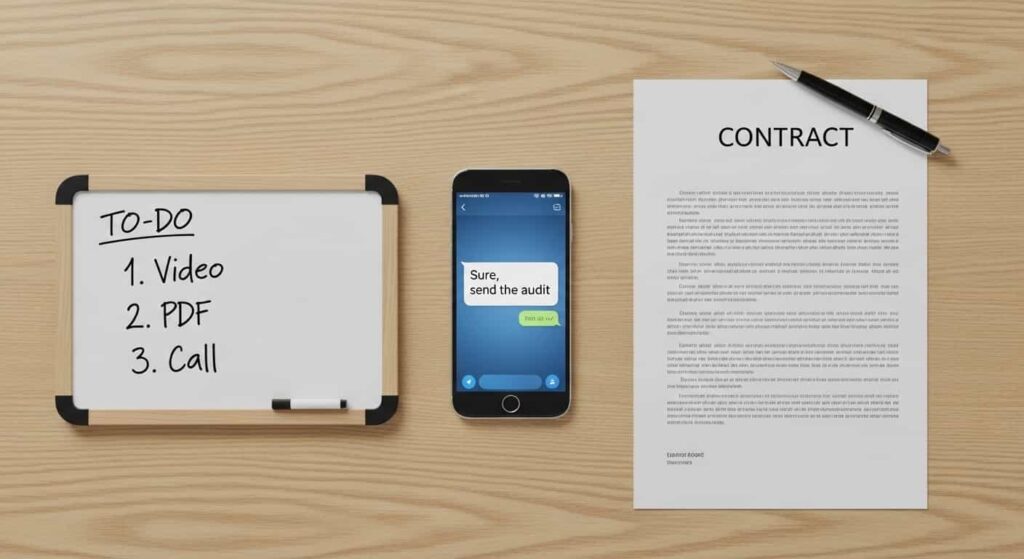
When they reply with “sure, send the audit” or “let’s chat,” your response should include three things:
- The audit video (2–3 minutes max—respect their time)
- A one-page PDF summary of findings (keeps you top of mind)
- A soft proposal: “If fixing these is a priority, I have capacity next week. Happy to hop on a 10-minute call to discuss a plan.”
This turns a curious prospect into a paying client without a hard sell. You’ve already demonstrated value. Now you’re simply offering a logical next step.
Conclusion: Code Is Logical, People Are Emotional

You can be the best coder in the world, but if you can’t get a reply to your email, your skills will never translate into income.
The three cold email templates for web developers provided above are not just about filling a text box. They are structured psychological frameworks designed to navigate the modern attention economy. They work because they:
- Respect the recipient’s time (short sentences, clear value).
- Trigger emotional responses (curiosity, loss aversion, ego).
- Provide value before asking for payment (audits, roadmaps).
In 2026, the web development market is saturated. But the market for trusted, consultative partners who understand business psychology is wide open.
Stop selling your ability to write div tags. Start selling your ability to solve anxiety, beat competitors, and protect reputations. Update these templates with your own voice, test them relentlessly, and watch your reply rates climb.
Frequently Asked Questions
How many emails should I send per day?
For cold outreach in 2026, quality over quantity. Aim for 20–50 highly personalized emails per day. Sending 500 generic emails will kill your domain reputation and yield zero replies.
Should I include my rates in the first email?
No. The goal of the first email is to start a conversation, not to close a deal. Quoting too early usually results in being ghosted because you haven’t built enough value yet.
What if I don’t have a huge portfolio?
Use the “Audit” method (see section above). You don’t need a portfolio of past clients to prove you can find errors. A Loom video analyzing their site is your portfolio. It demonstrates competence in real-time.
How long should my audit video be?
2–3 minutes maximum. Anything longer won’t get watched. Cover the problem, the impact, and the fix. Save the deep dive for the sales call.
What’s the best time to send cold emails?
Studies show that Tuesday through Thursday, between 8:00 and 10:00 AM in the recipient’s time zone consistently yields the highest open rates for B2B outreach.